A warning light appears while traffic is moving around you on I-95, Florida's Turnpike, or Okeechobee Boulevard. Your first job is not to diagnose the vehicle. Your first job is to get yourself and the vehicle to a location where you can make a safe decision.
Do not stop abruptly in a travel lane just to inspect the dashboard. Reduce speed smoothly, use your signals, and aim for the nearest genuinely safe refuge. That may be an exit, a parking area, a side location off the main traffic flow, or another place where you can get clear of moving vehicles. If you cannot safely reach a refuge and the vehicle is stopped or disabled in an exposed lane, contact emergency services or roadway assistance. Do not stand beside the vehicle in active traffic.
Make the first 60 seconds count
- Look at the road before the dash. Keep control of the vehicle and scan for a safe place to pull away from traffic.
- Notice what changed. Loss of steering assist, braking changes, smoke, steam, a burning smell, harsh noise, or a rapid temperature rise changes the decision.
- Choose a safe stopping point. On high-speed sections of I-95 or Florida's Turnpike, a narrow shoulder may not be a workable place to wait or load.
- Share your location clearly. Say the road, direction of travel if known, and the nearest safe pickup point. Around Palm Beach International Airport, access lanes and airport-area traffic can make the exact pickup point especially useful.
Decision point: If the vehicle has lost safe control, is smoking or steaming, has an active fluid leak, or cannot be moved out of immediate exposure, do not try to drive it farther. Get emergency or roadway assistance for the immediate hazard, then arrange the appropriate vehicle help.
Warning-light scenario matrix: what the light means for your next move
| What you see or feel | Safe next step | Roadside help or tow? |
|---|---|---|
| Red oil-pressure light, engine noise, burning smell, or visible leak | Pull over only when you can reach a safe location. Turn the engine off once stopped. | Choose secure transport. Do not restart or drive to a destination. |
| Temperature warning, steam, coolant smell, or gauge rising quickly | Move to a safe location if the vehicle remains controllable. Turn off the engine and allow it to cool. | Secure transport is the safer choice when there is steam, overheating, or coolant loss. |
| Battery or charging light with dim lights, repeated warning messages, or weak steering assist | Limit electrical use and get safely off the road. The vehicle may lose power as it continues. | Request roadside assessment if parked safely and the only issue is a warning light. Tow if it will not stay running or other symptoms appear. |
| Check-engine light flashing, shaking, power loss, or strong fuel smell | Reduce speed and pull into a safe location. Avoid hard acceleration. | Arrange a tow when the light flashes or the engine runs rough. A steady light with normal operation may allow a roadside assessment first. |
| Brake warning, soft pedal, brake pull, grinding, or reduced braking response | Slow gradually and stop at the nearest safe place. Use extra following distance while moving there. | Tow if braking feels different, the pedal is soft, or a brake warning remains on. |
| Power steering warning with heavy steering | Do not make sudden turns. Pull over when it can be done safely. | Roadside help may confirm the condition, but towing is the safer route if steering effort is high or control feels uncertain. |
| Tire-pressure warning with a pull, thump, vibration, or visibly low tire | Slow down and avoid sharp turns. Park on firm, level ground away from traffic. | Request flat tire service if the tire can be safely changed. Tow if the tire is damaged, multiple tires are affected, or the location is unsafe for roadside work. |
| Several lights appear at once, but the vehicle still drives normally | Do not assume every light means a separate failure. A low-voltage condition can trigger several alerts. | Get roadside assessment at a safe location. Choose towing if the vehicle stalls, loses critical functions, or warning signs continue with poor operation. |
Stop, continue briefly, or request transport?
Stop at the next safe place and do not continue if you have smoke, steam, a burning smell, an active leak, major loss of power, changed braking, heavy steering, severe shaking, or a flashing check-engine light. The goal is not the closest repair location. The goal is preventing more damage and avoiding a roadside hazard.
Continue only far enough to reach a genuinely safer location when a red warning appears but stopping immediately would leave you in an active lane, on a narrow shoulder, or near fast traffic. Keep the move short and controlled. Do not continue because the warning disappears.
Request roadside help first when the vehicle is safely parked, drives normally, and the problem may be limited to a discharged battery, a single tire issue, a lockout, or low fuel. A jump start or basic roadside assessment can clarify the next step without assuming a tow is needed. See roadside assistance options for situations that may be handled where the vehicle is parked.
Request a tow when the vehicle condition makes further driving uncertain, when roadside work cannot safely be done at the pickup point, or when you need to move the vehicle without placing extra load on its systems. For a warning-light situation that points to overheating, oil pressure, brake trouble, steering trouble, or unstable engine operation, request flatbed towing for secure transport.
Roadside checklist before help arrives
- Stay out of traffic. If you are safely parked, remain in a protected area away from moving vehicles when possible. Do not wait beside a traffic-facing door.
- Leave the vehicle off when the warning suggests damage. Do not restart after overheating, oil-pressure, smoke, steam, or unusual engine noise.
- Do not open a hot hood. Steam and hot components create risk. You can report what you saw without inspecting under the hood.
- Take a clear dashboard photo. Capture the warning lights and any message displayed. This helps explain the vehicle condition.
- Note the symptoms. Record when the light came on and what followed: power loss, vibration, smell, temperature rise, steering change, or brake change.
- Use hazard flashers when appropriate. They can help make a stopped vehicle more visible, but they do not make an exposed lane safe.
- Keep your phone available. Avoid draining it with unnecessary calls or apps while coordinating the pickup.
Prepare the service call for a clean pickup
Give the dispatcher the vehicle year, make, model, color, and the dashboard warning or symptom. Then give the exact pickup point, not just a nearby road name. “On Okeechobee Boulevard” may still leave a long stretch of roadway. Add the direction of travel, a nearby cross street if visible, and whether you are in a parking area, shoulder, ramp, or access lane.
On Australian Avenue, Southern Boulevard, and around Okeechobee Boulevard, traffic conditions can affect where a truck can safely approach and load. Mention blocked access, low clearance, a parking-garage level, or a position near airport-area traffic. If the vehicle is on I-95 or Florida's Turnpike, explain whether it is fully off the travel lane and whether you have reached a safer pickup location.
- Tell the provider if the vehicle rolls, starts, shifts into neutral, or has a locked steering wheel.
- Share the destination before loading begins.
- Remove valuables and gather keys, registration, and any items needed at the destination.
- Do not attempt to push the vehicle into a better position if traffic is close or the vehicle has a brake, steering, or power problem.
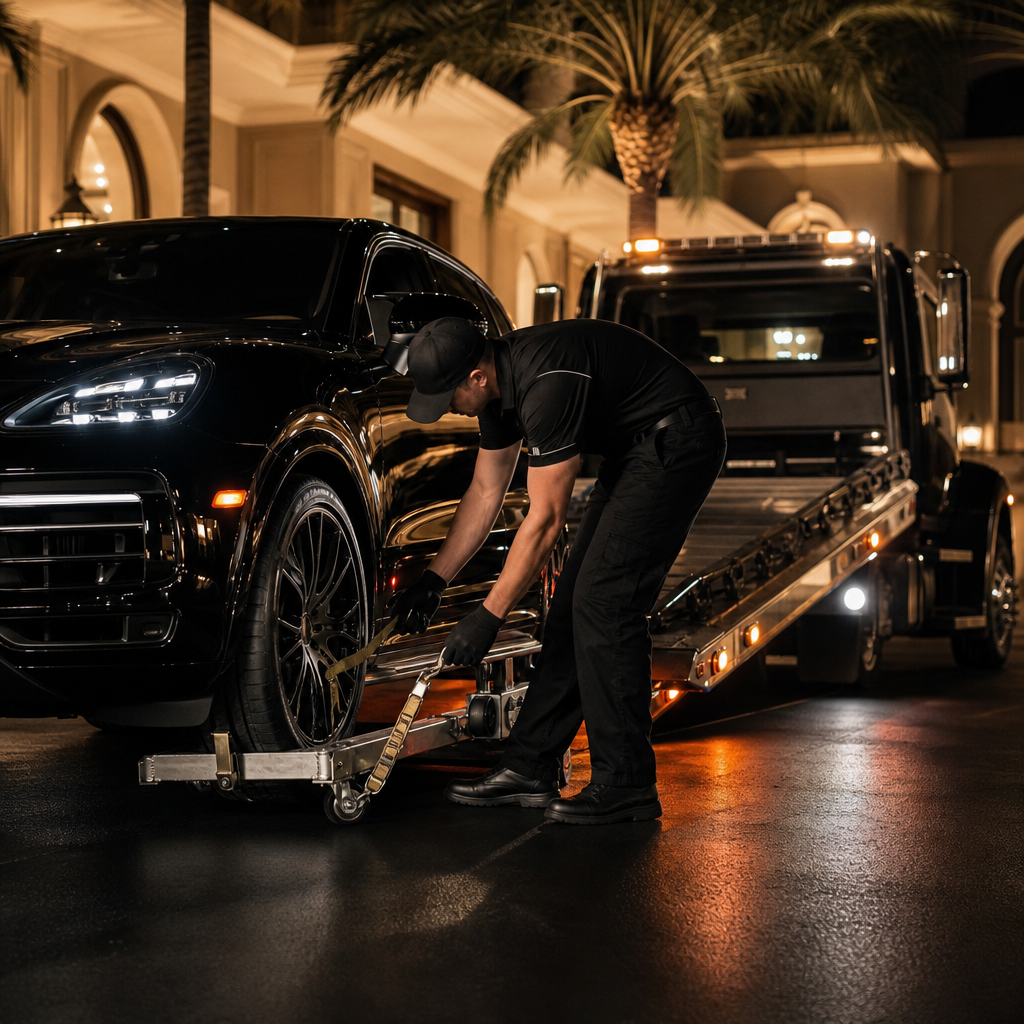
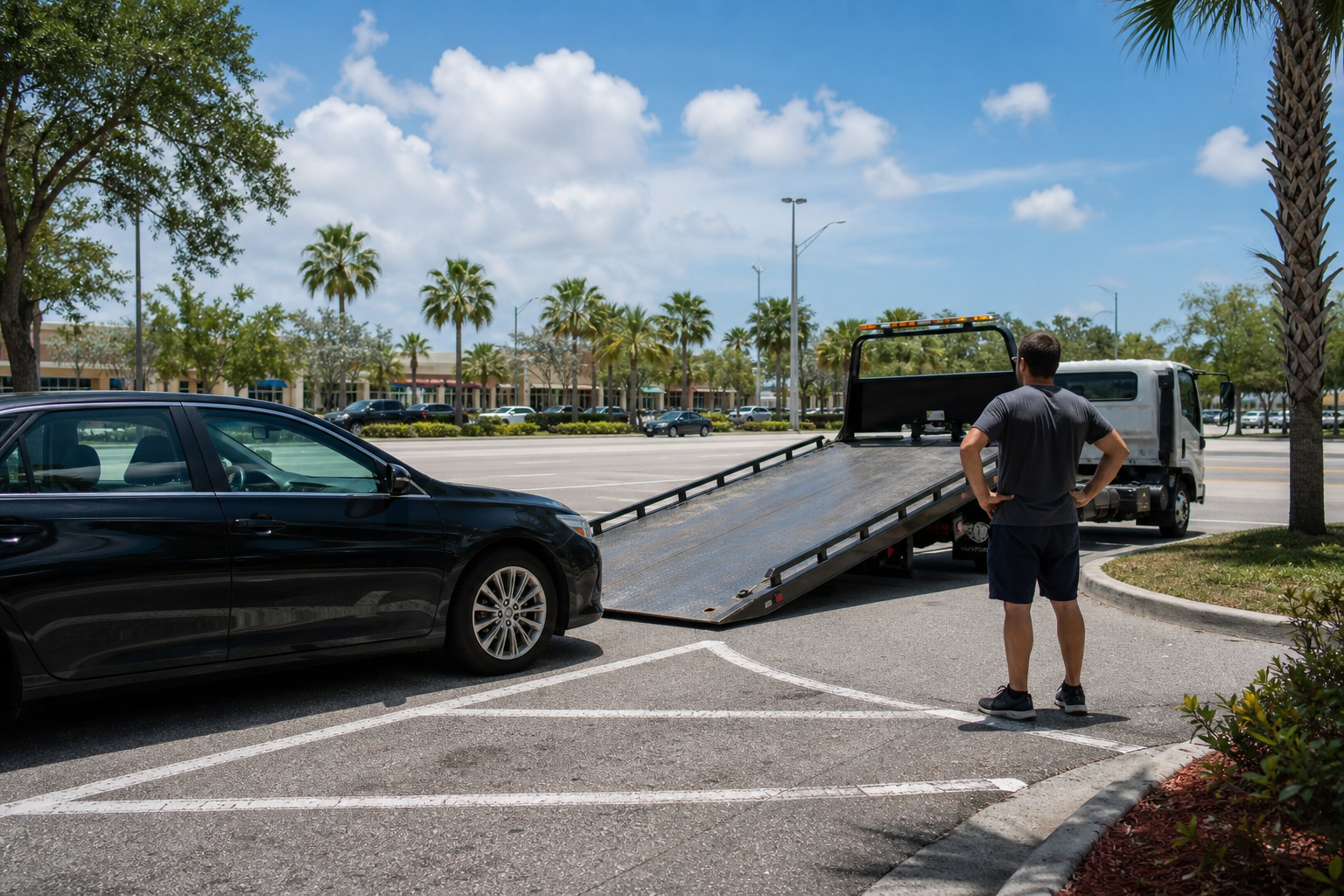
Flatbed loading can be a practical fit when the vehicle should not be driven, has a damaged tire, is overheating, or has warning signs that make wheel-on-road travel a poor choice. The service decision should follow the vehicle condition and pickup point, not the dashboard icon alone.
Choose the next step based on what the vehicle is telling you
If the warning light comes with smoke, overheating, oil-pressure concerns, brake changes, steering changes, or rough engine operation, Request Flatbed Towing. If the vehicle is safely parked and the issue appears limited to a battery, flat tire, lockout, or fuel shortage, Get Roadside Help. If you are exposed in an active lane and cannot safely reach refuge, contact emergency services or roadway assistance first.
Quick answers for West Palm Beach drivers
Can I drive with a red warning light on?
Do not treat it as a routine drive. Move only as far as needed to reach the nearest safe location when stopping immediately would create greater danger. Once safely parked, assess the symptoms and arrange help if the warning involves oil pressure, temperature, brakes, steering, or engine operation.
Do multiple dashboard lights always mean I need a tow?
No. Multiple lights can appear after a low-voltage or charging issue. If the vehicle is safely parked and operating normally, roadside assessment may be appropriate. Tow the vehicle when it stalls, loses critical functions, or has warning lights combined with unsafe driving symptoms.
What should I do if my vehicle stops on I-95 or Florida's Turnpike?
Prioritize getting out of active traffic if you can do so safely. If you cannot reach a safe refuge, contact emergency services or roadway assistance. Do not stand outside near moving traffic or attempt roadside repairs in an exposed position.
Can roadside help handle a battery light?
It can help assess a parked vehicle and address a simple low-battery situation. A battery light can also point to a charging problem, so a jump start may not mean the vehicle is safe to continue driving. If it dies again, dims, or loses vehicle functions, arrange transport.
What information helps a tow truck find me around Palm Beach International Airport?
Give the exact access lane, parking area, entrance, or nearby roadway point. State whether the vehicle is in a moving-traffic area and describe any access limits. A precise pickup point helps match the approach to airport-area traffic conditions.