Roadside Help for Overnight Battery Trouble in West Palm Beach
Do not keep turning the key or pressing the start button if you smell chemicals, see smoke, or notice a swollen or leaking battery. Repeated start attempts can add heat or create sparks. The safer alternative is to stop, move away from the vehicle, and identify whether you have a hazardous battery condition, a routine no-start, or a problem that requires towing.
If there is fire or immediate danger, contact emergency services. Do not open the hood, lean over the battery, or touch it to check the temperature. Tell any roadside or towing dispatcher about smoke, leaking fluid, hissing, swelling, or signs that the battery appears unusually hot.
Do This Now: A 60-Second Safety Check
- Stop repeated start attempts. One brief attempt is enough to note what the vehicle does.
- Check the surroundings. If the vehicle is exposed to moving traffic, stay in a protected location and request help rather than working beside it.
- Use your senses without touching the battery. Look for smoke, steam, case distortion, or leaking fluid. Listen for hissing. Notice any sharp chemical or burning odor.
- Move away if a hazard is present. Keep other people away, avoid opening or touching the battery area, and disclose the condition to dispatch.
- If no hazard is present, note the symptom. A click, rapid clicking, dim lights, complete silence, or normal cranking can point to different next steps.
Do and Don’t: The Overnight No-Start Decision
| Do | Don’t |
|---|---|
| Move away and call emergency services if there is fire or immediate danger. | Do not open the hood or approach a smoking, leaking, hissing, or visibly overheated battery. |
| Check the owner’s manual before connecting jump equipment. | Do not guess at battery terminals, grounding points, or hybrid and electric-vehicle procedures. |
| Request roadside help if the vehicle is safely positioned and shows ordinary low-battery symptoms. | Do not attempt a jump while standing in traffic, deep water, or an unsafe access area. |
| Choose towing when the vehicle starts and dies, has visible damage, or cannot be safely tested where it sits. | Do not assume every no-start is a battery problem. |
| Give dispatch a precise pickup point and access details. | Do not rely only on a broad West Palm Beach neighborhood description. |
Step-by-Step Actions Based on What the Car Does
1. Record one clean start attempt
Turn off the lights, climate controls, audio system, and connected accessories. Make one short start attempt, then stop. Tell dispatch which of these results occurred:
- Rapid clicking or dimming lights: often consistent with low available battery power.
- One click with no engine movement: may not be solved by a jump.
- No sound and no dash lights: could involve the battery connection, battery charge, or another electrical issue.
- The engine cranks normally but does not start: this is not a typical weak-battery pattern.
This symptom report helps a dispatcher decide between jump-start service, broader roadside help, and towing.
2. Decide if the location allows roadside work
A jump start requires room for a technician to reach the vehicle and work away from moving traffic. Tell dispatch if the car is in a travel lane, narrow access point, gated property, parking structure, or space blocked by other vehicles.
For a West Palm Beach pickup, send a GPS pin plus the nearest posted address. Include the entrance to use, parking level or space number, gate instructions, and the direction the vehicle faces. These details are more useful than saying only that the car is at a home, store, or parking lot.
3. Rule out conditions that make a jump unsafe
Do not jump a battery that is cracked, swollen, frozen, leaking, smoking, hissing, or showing burn damage. Do not proceed if the cables are frayed, clamps are loose or corroded through, or the jump pack is damaged.
Water around the vehicle can also make access unsafe. After rain, do not stand in pooled water while handling electrical connections. Request roadside assistance and explain the access condition before anyone is sent.
4. If you perform a jump, control the spark and connection risks
Use the vehicle owner’s manual and the jump device instructions. Battery locations and approved grounding points vary, especially on hybrids, electric vehicles, and vehicles with remote jump terminals. If the correct points are unclear, stop and call for help.
- Inspect the cables, clamps, and jump pack for damage before use.
- Remove loose metal jewelry and keep tools away from terminals.
- Wear eye protection when available.
- Keep flames, cigarettes, and sparks away from the battery area.
- Keep your face and body out of the space directly above either battery.
- Confirm polarity before making each connection.
- Use the manufacturer-approved ground point rather than improvising.
Stop if a clamp sparks heavily, a cable becomes hot, the battery changes shape, or a chemical odor appears. Move away and report the condition.
5. Treat a successful jump as a temporary result
If the engine starts and runs normally, head only to a nearby safe service or battery-testing location. Avoid shutting the engine off before reaching that location, but do not continue driving if warning lights appear, lighting becomes unstable, or the engine begins to lose power.
An unresolved charging fault can cause the vehicle to stall while moving. If operation becomes abnormal, pull into a safe position when possible and request emergency towing rather than trying repeated jumps.
6. Choose towing when the vehicle cannot prove it can move safely
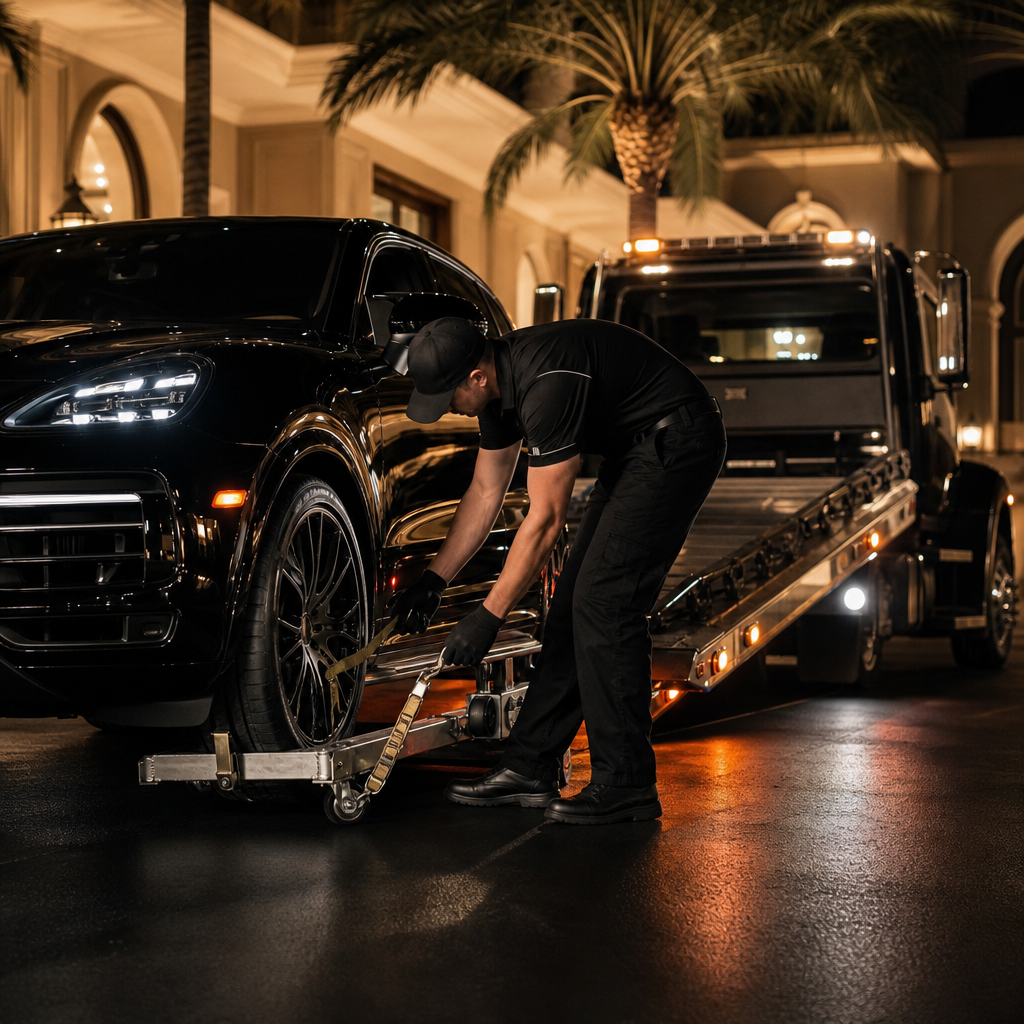
Towing is the clearer next step when the car starts and dies, will not shift properly, has electrical burn signs, has collision damage, or sits where a jump cannot be performed safely. A flatbed may also suit vehicles with low clearance, all-wheel drive requirements, transport restrictions, or uncertain vehicle condition.
Tell dispatch the year, make, model, drive type if known, whether the wheels roll, whether steering works, and whether the parking brake releases. Also provide the planned destination. This allows the operator to prepare for safe loading and secure transport. See flatbed towing options when roadside power alone will not resolve the pickup.
West Palm Beach Dispatcher Checklist
Have these details ready before requesting service:
- GPS pin and nearest posted street address
- Property entrance, gate code or call-box instructions
- Garage level, parking space, height limits, or tight access
- Vehicle year, make, model, color, and plate if available
- What happened during the single start attempt
- Any smoke, odor, leaking, swelling, heat signs, or warning lights
- Whether the vehicle is blocking traffic or safely parked
- Keys available, wheel position, and parking-brake status
- Preferred nearby service or transport destination
When to Stop Troubleshooting and Call
Call emergency services first for fire or immediate danger. Move away, keep others back, and do not reopen or touch the vehicle.
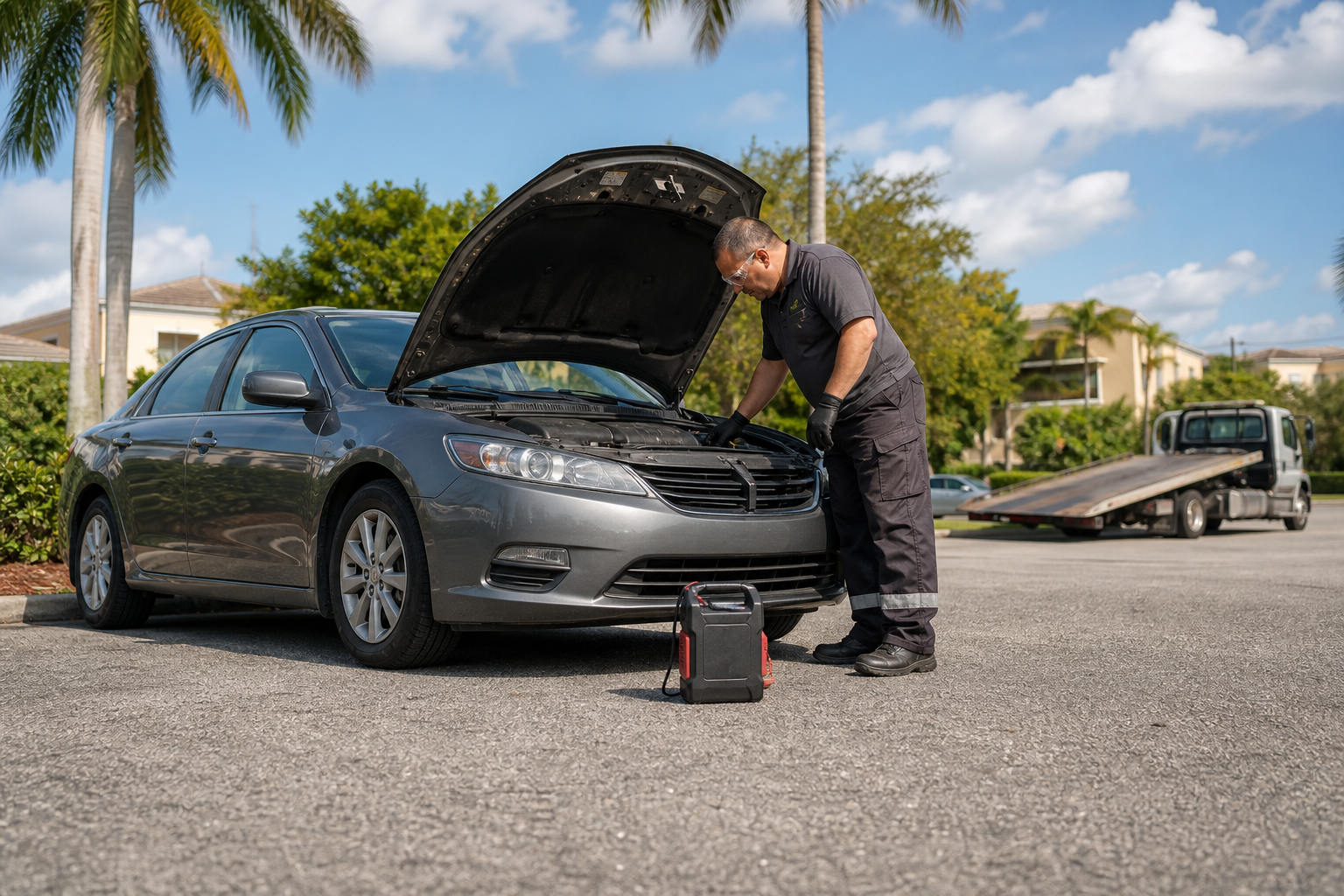
Get roadside help when the vehicle is safely parked, there are no battery damage signs, and the symptoms fit a discharged battery. Request towing when access is unsafe, the vehicle starts and dies, the engine cranks normally without starting, visible damage is present, or a jump attempt does not restore stable operation.
Safety-first next step: Share the exact West Palm Beach pickup point, vehicle condition, and access limits before service is dispatched.
Frequently Asked Questions
Should I keep trying if the car clicks but will not start?
No. Repeated attempts can drain the remaining power and add heat. Make one brief attempt, note whether the clicking is rapid or a single click, and give that information to roadside dispatch.
Can roadside service test or jump the battery where the car is parked?
Often, if the vehicle is accessible and there are no signs of battery damage. Tell dispatch about traffic exposure, gates, garage clearance, pooled water, or blocked access so the service can be matched to the pickup point.
Should I drive after a successful jump?
Drive only to a nearby safe service or testing location if the vehicle runs normally. A charging problem can cause another shutdown or a stall. Stop and request towing if warning lights, flickering lights, loss of power, or unstable operation appears.
When is a flatbed more appropriate than another jump attempt?
Use a flatbed when the vehicle starts and dies, has visible damage, cannot be accessed safely, or has transport requirements that rule out ordinary towing. Give dispatch the vehicle type, drive system, wheel condition, pickup access, and destination.
What should I do if the battery is smoking or leaking?
Move away and keep other people clear. Do not open the hood, touch the battery, or attempt a jump. Contact emergency services if there is fire or immediate danger, and disclose the smoking or leaking condition to any towing or roadside dispatcher.