
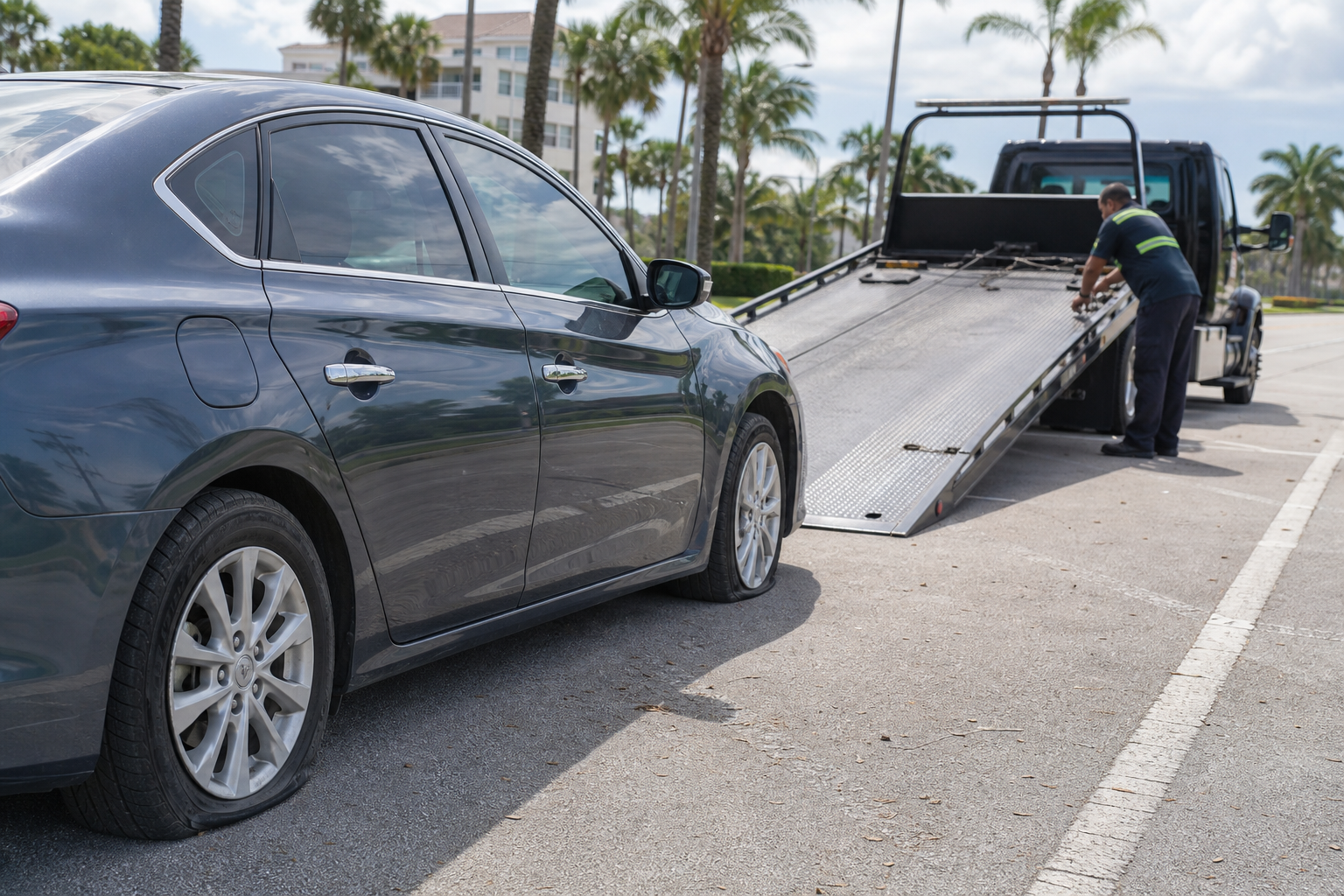
Flatbed Towing in West Palm Beach When Your Spare Tire Is Not Safe to Use
You feel the steering change and hear the steady thump of a tire losing air. After easing off the accelerator, you find a place to stop and open the trunk. The next question is not simply whether a spare is present. You need to know whether the location, tools, and spare make a roadside change safe.
A usable spare may allow a roadside technician to get the vehicle moving. A damaged, underinflated, or missing spare usually shifts the next step to towing.
Right now: stabilize the situation
- Hold a steady path. Ease off the accelerator and avoid sharp steering or hard braking.
- Move out of active traffic if the vehicle remains controllable. Look for a firm, level stopping point with space around the affected wheel. Do not keep driving solely to find a more convenient location if the wheel is grinding, the vehicle will not steer normally, or body damage is present.
- Make the vehicle visible. Turn on the hazard flashers, select Park or an appropriate gear, apply the parking brake, and switch off the engine.
- Assess exposure before getting out. Do not stand beside the damaged tire if passing traffic leaves little working room. If the vehicle faces an immediate collision risk, prioritize personal safety and contact emergency services.
Describe the pickup point, not just the map pin
Location accuracy helps a dispatcher match the service and approach. A phone pin may identify the general area while missing the entrance, parking level, or side of a property where the vehicle is stopped.
Give the West Palm Beach address or nearest confirmed address when available. Then describe the entrance you used, your position within the property, the direction the vehicle faces, and the affected corner of the car.
- Vehicle year, make, model, color, and plate state
- Exact pickup point, including a lot section, building side, floor, or row if applicable
- Gate, height, turning-space, or access restrictions
- Which tire is flat and whether it is shredded, off the rim, or simply low
- Whether the vehicle rolls, steers, and shifts into neutral
- Whether a spare, jack, lug wrench, and wheel-lock key are available
- Your intended destination if towing may be needed
Tell the dispatcher if the vehicle is in a garage or confined parking area. Clearance and loading space can affect equipment planning and the safe pickup approach.
Check the spare before anyone lifts the vehicle
A spare can look intact but still be unsuitable. Find out whether it is a full-size wheel, a compact temporary spare, or no physical spare at all. Some vehicles carry an inflator or sealant kit instead.
A spare is not ready if any of these apply
- The tire is visibly flat, cracked, cut, bulged, or separated.
- The wheel is bent, heavily corroded, or otherwise damaged.
- The valve stem is damaged or leaking.
- The spare does not match the vehicle or will not clear the brakes.
- You cannot confirm the required inflation from the tire label or owner’s manual.
- The compact spare’s printed restrictions cannot be read or followed.
Do not assume a compact spare uses the same pressure or driving limits as the regular tires. Read the spare’s label and the vehicle manual. Temporary-spare speed and distance limits vary, so a universal rule is not reliable.
Use this test before attempting a tire change
A roadside change only makes sense when every part of the setup is workable. Stop and request flat tire service if any answer is no.
- Is the vehicle on firm, level ground?
- Is there enough room to work without entering a traffic lane?
- Is the spare inflated and visibly undamaged?
- Are the correct jack, lug wrench, and wheel-lock key present?
- Can you identify the approved jacking point in the owner’s manual?
- Can the damaged wheel be removed without working under the vehicle?
If you perform the change, follow the vehicle manufacturer’s sequence. Keep everyone clear while the vehicle is raised, never place any part of your body under a vehicle supported only by its roadside jack, and tighten the wheel fasteners using the pattern and specifications in the manual.
Once installed, treat a compact spare as temporary equipment. Follow its printed restrictions and arrange the proper next step at your chosen destination.
If the vehicle has no spare
Check for a manufacturer-supplied inflator or sealant kit. Use it only as directed. A sealant kit is not a suitable answer for every tire failure, especially visible sidewall damage, a shredded tire, a tire separated from the rim, or wheel damage.
If the vehicle has run-flat tires, consult its display and owner’s manual before driving. Remaining driving capability depends on the tire condition and manufacturer guidance. Do not assume the tire can continue simply because it is labeled run-flat.
When the kit cannot be used, has expired, or does not restore inflation, towing is the practical handoff.
Choose roadside help or secure transport
Request roadside service when a safe working area and a confirmed usable spare are available. Share the tool and access details before dispatch so the technician knows the likely task.
Request flatbed towing when there is no usable spare, the location is unsafe for jacking, the wheel is damaged, or the vehicle does not roll or steer normally. A flatbed may also be the appropriate choice when accident damage, low clearance, drivetrain requirements, or the vehicle manufacturer’s instructions call for all wheels to remain off the road.
Before pickup, remove only the personal items you need and keep the key available. Identify the destination and disclose visible vehicle damage. The operator can then plan safe loading based on vehicle condition, access, and available space.
Spare and service readiness checklist
- Locate the spare or inflator kit before a roadside problem occurs.
- Check the spare’s pressure using the specification provided for that spare.
- Inspect it for cracks, cuts, bulges, and rim damage.
- Confirm that the jack and lug wrench fit the vehicle.
- Keep the wheel-lock key where it can be found without unloading the vehicle.
- Know where the owner’s manual lists jacking points and spare restrictions.
- Save accurate vehicle details and consider the likely towing destination.
Spare tire and roadside help FAQs
Can I drive normally on a compact spare?
No. Follow the speed, distance, inflation, and placement restrictions printed on the spare and listed in the owner’s manual. If those instructions are missing or unreadable, ask for roadside guidance rather than guessing.
Can roadside assistance install my spare?
Usually, a tire change is a roadside-help task when the spare and tools are usable and the location provides safe access. Tell the dispatcher what equipment is present and which tire is affected.
What if my spare is flat too?
Do not install it. Report that both the road tire and spare are unusable, then request towing to your chosen destination.
Should I use tire sealant instead of calling for help?
Use sealant only when the vehicle manufacturer’s instructions allow it for the specific damage. Visible sidewall, wheel, or severe tire damage calls for a different next step.
When is a flatbed needed for a flat tire?
Use a flatbed when there is no usable spare, roadside access is unsafe, the wheel or vehicle is damaged, or manufacturer guidance requires secure transport. Share the vehicle type, condition, pickup point, access limits, and destination when requesting service.