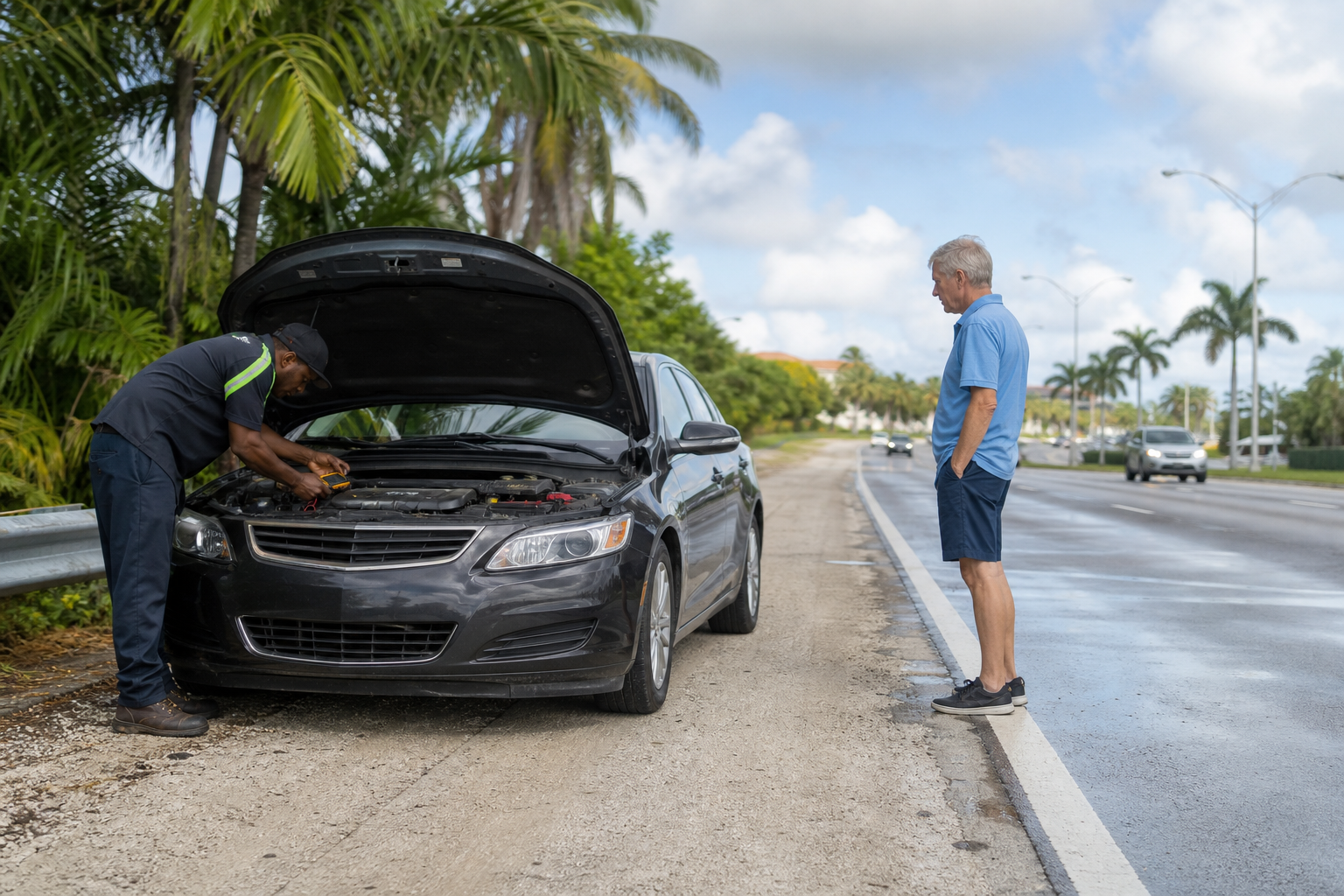
The highest-risk mistake is opening the hood while your vehicle is stopped in an active traffic lane. Do not diagnose the battery beside moving traffic. If the vehicle cannot reach a safe position, keep yourself protected, use hazard lights if they work, and contact emergency services as appropriate for the immediate collision risk. Arrange roadside help or towing only after the traffic danger is addressed.
Risk signals: read the pattern, not one symptom
A dead battery and a failed alternator can both leave a car unable to start. Loose cables, damaged wiring, a worn belt, or a starter problem can create similar symptoms. Warning signs narrow the possibilities, but only a roadside voltage or charging-system test can separate a weak battery from an alternator, belt, or wiring fault with confidence.
| What you observe | What it may indicate | Next step |
|---|---|---|
| Rapid clicking, slow cranking, or lights that dim sharply when you try to start | Weak battery, poor battery connection, or another high-resistance electrical fault | Request a safe jump start and battery test. |
| No interior lights and no dashboard response | Discharged battery, loose terminal, main electrical connection, or fuse issue | Do not assume a jump will fix it. Ask for inspection and testing. |
| The engine starts after a jump and continues running normally | A discharged or aging battery is more likely, but the charging system is not cleared | Have battery and charging voltage tested before relying on the vehicle. |
| The engine starts after a jump, then stalls soon afterward | Alternator, belt, wiring, or charging-system failure is more likely | Stop repeated jump attempts and arrange towing. |
| A battery-shaped warning light appears while the engine is running | The charging system is not operating normally; it does not automatically mean the battery is bad | Reduce electrical use and reach a safe stopping place. Request testing or towing. |
| Lights flicker, electronics reset, or several warnings appear before the engine stalls | System voltage may be falling while the car is running | Treat this as a likely charging failure and avoid continuing in traffic. |
Signs that lean toward a discharged battery
The vehicle was slow to crank before the no-start, lights were left on, or the car sat unused before the problem appeared. Florida heat can accelerate battery wear, but heat exposure alone does not identify the failed part. A jump followed by stable operation is another battery-leaning clue, not a final diagnosis.
Signs that lean toward an alternator or charging fault
The vehicle loses electrical power while already running, the battery warning light appears during the trip, or the engine dies again after a jump. A damaged drive belt or wiring connection can produce the same pattern. If steering effort changes, temperature rises, or you smell burning material, stop in the nearest safe position and do not continue driving.
Safe actions: choose help based on location and symptoms
- Judge traffic exposure first. Bright Florida daylight can make hazard lights less noticeable, while rain can reduce roadside visibility. Do not stand between your car and moving traffic or work under the hood without protected space.
- Check for battery hazards without touching anything. Do not attempt a jump if the battery looks swollen, cracked, frozen, or wet with leaking fluid. Smoke, sparks, a strong sulfur-like odor, or melted wiring also call for towing rather than a jump.
- Use roadside testing when the work area is safe. If the vehicle is fully out of traffic and shows no battery damage, roadside assistance can provide a jump and determine whether the charging voltage is present.
- Follow vehicle-specific jump instructions. Some vehicles use remote jump points or require special procedures. A technician providing jump-start service should identify the correct connection points before attaching cables.
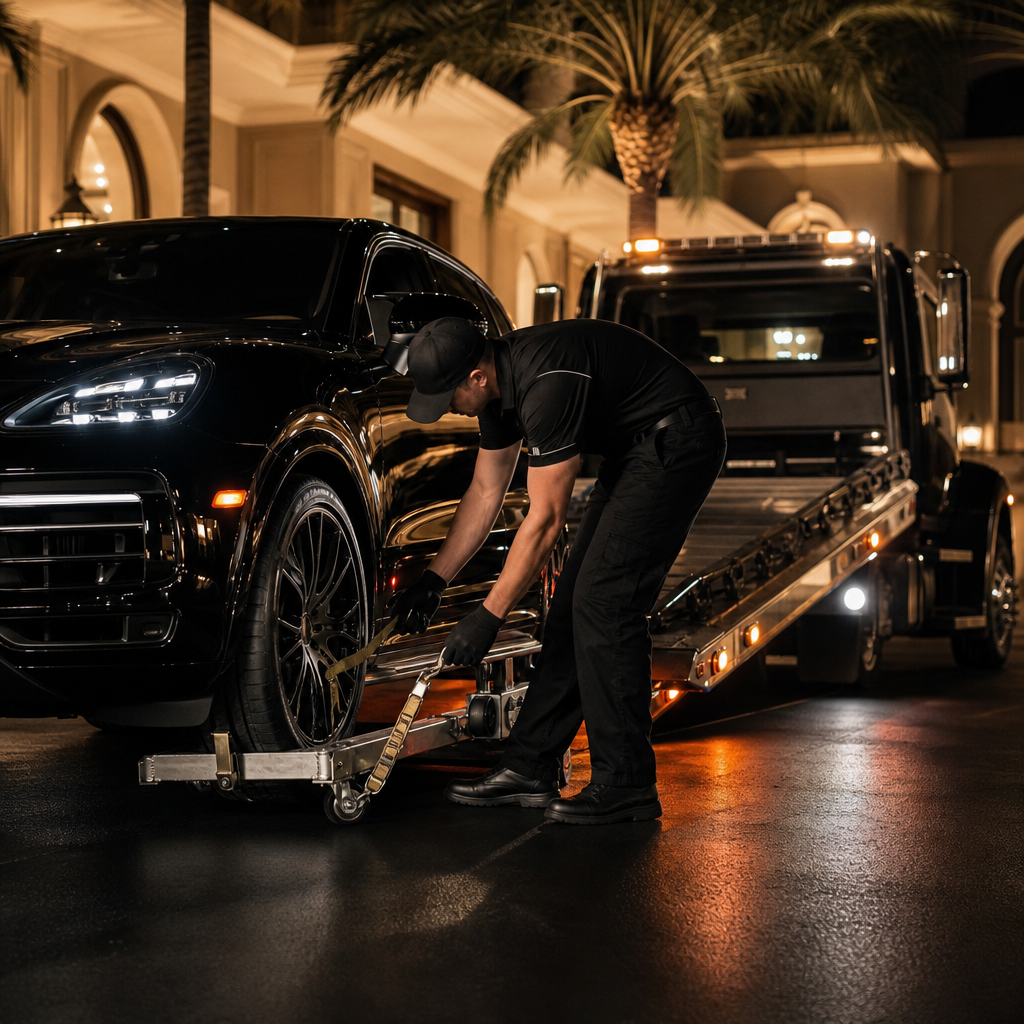
- Choose towing when the vehicle cannot stay running. Arrange emergency towing if the engine stalls after a jump, the charging warning returns, a belt appears damaged, or there is no safe place to test the vehicle.
Do not try to “charge the battery” by idling or driving through West Palm Beach traffic after an uncertain jump. If the alternator is failing, the vehicle may stall again with less warning. A second shutdown can leave you in a more exposed location.
Avoidable mistakes that can make the situation worse
- Calling every no-start a dead battery. A click, dim light, or successful jump is a clue. It is not a complete charging-system diagnosis.
- Disconnecting a battery cable while the engine runs. This old alternator test can damage modern vehicle electronics. Use proper voltage and charging-system equipment.
- Making repeated jump attempts. Stop if cables heat up, connections spark excessively, the starter will not turn, or the engine dies again.
- Using an unknown battery or cable layout. Reversed polarity can cause severe electrical damage. Check the owner’s manual or wait for roadside help.
- Opening the hood in a live lane. Vehicle diagnosis can wait. Immediate traffic danger cannot.
Decision checklist: what to report and which service to request
Before calling, collect only the details you can observe safely:
- Is the vehicle fully outside moving traffic?
- Does the engine crank slowly, click, crank normally, or do nothing?
- Did a battery warning light appear while the engine was running?
- Did the vehicle stall while moving or only fail after being parked?
- Was a jump attempted, and did the engine remain running afterward?
- Is there smoke, odor, leaking fluid, a swollen battery, or a damaged belt?
- What is the vehicle year, make, model, and current pickup point?
Request a jump and test when the car is safely positioned, the battery shows no physical damage, and the main symptom is a weak or absent crank. Request towing when the car dies while running, stalls after a jump, shows charging-system symptoms, or cannot be serviced away from traffic. If collision risk is immediate, contact emergency services as appropriate before arranging vehicle assistance.
Questions drivers ask at the roadside
Can warning signs prove that the alternator is bad?
No. Stalling, flickering lights, and a battery warning light point toward a charging fault, but the alternator, belt, wiring, or connections may be responsible. A voltage and charging-system test is needed.
Does a successful jump mean only the battery is bad?
No. A jump supplies temporary outside power. If the alternator is weak, the vehicle may start and then stall once that outside power is removed.
Should I drive after the engine starts?
Not until you have considered where the vehicle might stop again. If charging output has not been tested, roadside testing or towing is safer than entering traffic and hoping the battery recovers.
Can roadside service test the car during rain or heavy traffic?
Only when there is enough protected working space. Poor visibility, an active lane, unstable ground, or close traffic may make towing the safer next step.
Get the right help without guessing
Tell the dispatcher where the vehicle is positioned, what the dashboard showed, how the engine cranked, and what happened after any jump attempt. Request roadside help for safe testing or towing when the vehicle cannot run reliably.
Get Roadside Help